What Your Brand Can Learn From Prime, Logan Paul's Billion-Dollar Brand
 Mohit Kumar
On this page
- Introduction
- Pro Tip
- The Rise: How Prime Hit $1.2 Billion in 18 Months
- The Fall: What Happened After the Hype Faded
- What the Rise Actually Teaches
- What the Fall Actually Teaches
- The Same Mechanism, at a Scale You Can Actually Use
- The Playbook: How to Apply This Without a Celebrity Budget
- What This Actually Looks Like on a Real Budget
- Key Takeaways
- The Bottom Line
In January 2022, YouTubers Logan Paul and KSI launched a sports drink out of nowhere. Within eighteen months, Prime Hydration hit an estimated $1.2 billion in global sales, sold its billionth bottle faster than any beverage brand in memory, and became the official hydration partner of UFC, Arsenal, and Barcelona. Stores sold out on restock day. Bottles that retailed for a few dollars were reselling for over $100. Around the same time, another YouTuber, Jimmy Donaldson — better known as MrBeast — turned a chocolate bar called Feastables into a business that, by 2024, was generating more profit than his own media empire. Few stories illustrate the raw power of the creator economy as clearly as these two.
It's tempting to read those numbers and conclude that creator partnerships are a shortcut to a billion-dollar valuation. They're not, and the real story is considerably more useful than that headline version. What Prime and Feastables actually prove isn't that fame guarantees success — it's that creator trust converts into sales at a rate paid advertising simply can't match. That mechanism doesn't require 100 million subscribers or a household-name founder. It requires understanding how the mechanism actually works, and applying it deliberately at whatever scale your brand operates at today.
This matters more than ever heading into 2026, as brands face rising paid-media costs and shrinking organic reach on nearly every platform. More brands are turning to influencer partnerships not because it's trendy, but because the underlying economics have quietly become more favorable than the alternatives.
The biggest mistake brands make copying these stories is chasing the mega-creator instead of the mechanism. Fame is one expensive way to earn trust. It isn't the only way — and for most brands, it isn't the smartest one to reach for first.
The Rise: How Prime Hit $1.2 Billion in 18 Months
Neither Prime nor Feastables is really a story of a brand paying an influencer to endorse it. Look closely at the actual company structures and both follow the same pattern: a creator with a massive built-in audience, paired with an experienced operator running the real business underneath the hype.
Prime is majority-owned and operated by Congo Brands, an established beverage company that handles manufacturing, distribution, and product development — the same team that had already built Alani Nu and 3D Energy Drink before Prime. Logan Paul and KSI hold the remaining 40% of the company (20% each) as the public-facing co-founders and the brand's primary marketing engine. Feastables followed a near-identical playbook: Donaldson brought in Jim Murray, the former president who took RXBAR from a startup to a $600 million acquisition by Kellogg, specifically to run operations while Donaldson's audience drove distribution and demand. In both cases, the creator supplied the attention. Someone with real operational experience supplied everything else.
That combination is what produced the actual numbers. Scarcity did the rest: deliberately limited retail allocation turned Prime into an event every time it restocked, with bottles reselling for well over $100 and retailers capping purchases per customer. Within a year, Prime had signed headline sponsorships with UFC, Arsenal, and FC Barcelona — deals that would normally take an established beverage brand a decade to land, secured almost entirely on the strength of Logan Paul and KSI's combined audience.
The Fall: What Happened After the Hype Faded
The highlight-reel version of this story usually stops at the peak. The rest of it is the part worth actually studying. By 2025, Prime's global revenue had reportedly fallen roughly 76% from its 2023 high, down to around $300 million, and the brand faced regulatory pushback in several markets — the Netherlands banned Prime Energy from sale over caffeine levels 2.5 times the legal limit, and Denmark's food safety authority ruled it illegal to sell for the same reason. In the UK, 2024 sales fell to less than a third of the previous year's peak, and products that once sold out in minutes began appearing on clearance shelves.
The clearest evidence of how far the fall went came in July 2026, when Congo Brands Australia — the company's Australian distributor — entered voluntary administration. Its most recent financial filing showed revenue collapsing from roughly A$31 million in FY23 to A$14.5 million in FY24, a 53% drop, alongside a net loss of A$1.42 million and just A$84,855 left in the bank against A$7.92 million in liabilities. Inventory fell from A$28.9 million to A$1.7 million, including a A$4.57 million writedown of stock no longer expected to sell. A packaging supplier separately filed a Federal Court application to wind the company up. The Australian arm remains reliant on financial support from Prime's US-based parent company while the administration process plays out — this wasn't the end of Prime globally, but it was a genuine, formally documented business failure in one of its biggest markets.
Feastables tells the opposite story over the same stretch: $250 million in revenue and over $20 million in profit in 2024 alone, now sold in more than 30,000 retail locations, still growing.
What the Rise Actually Teaches
The rise proves the core mechanism works, and works fast: creator trust, backed by real operational capacity, can compress years of normal brand-building into months. Scarcity and exclusivity amplified that trust into genuine cultural events. Neither brand needed a traditional advertising budget to do it — they needed an audience that already believed the creator, and an operator that could turn that belief into product on shelves.
What the Fall Actually Teaches
The fall proves something the rise can't: that attention and operational infrastructure aren't the same thing, and having "a real company" behind a creator brand doesn't automatically guarantee that company executes well. Congo Brands is a genuine, experienced beverage operator — and its own Australian arm still collapsed under rapid inventory writedowns and an overextended international rollout. The lesson isn't just "pair a creator with an operator." It's that the operator's actual discipline — how carefully it manages inventory, expansion pace, and regulatory compliance market by market — matters just as much as its existence. Prime scaled internationally faster than its operations could support, and leaned on viral marketing spectacle (NASCAR liveries, arena sponsorships) that generated spikes without building the loyalty needed to survive once the novelty faded. Feastables, over the same period, built real retail infrastructure first and was willing to overhaul its own product when the data called for it — a slower, less flashy approach that's precisely why it kept growing while Prime's Australian business ran out of cash.
The takeaway isn't "get famous," and it isn't "find a big operator" either. It's that attention converts fast, but it only compounds into a lasting business when real operational discipline — not just operational presence — stands behind it. That's genuinely useful if you're not a creator with 20 million followers, because it means the parts of this playbook you actually can't replicate — the fame, the overnight scarcity hype — were never the parts that determined whether the business survived.
The Same Mechanism, at a Scale You Can Actually Use
You don't need one mega-creator. You need the trust dynamic they represent, and that dynamic is available at every level of the creator economy, not just at the top of it. A blended mix of nano and micro creators recreates the same fundamental exchange — an audience trusting a voice they already follow, rather than tuning out another ad — at a fraction of the cost and risk of betting your entire marketing budget on one name.
It also gives you something Prime and Feastables didn't have the luxury of at launch: room to test before you commit. Neither brand had the option to run a small pilot with a handful of creators, measure what actually converted, and scale only the approach that worked. They launched into instant, massive scale because that's what a launch backed by 100+ million combined subscribers looks like — and Prime's collapse in Australia shows exactly what happens when that scale outruns the operational discipline needed to sustain it. Most brands get to do this the smarter way — test small, measure what actually drives sales, and only then commit real budget to what's proven.
The Playbook: How to Apply This Without a Celebrity Budget
This is where strategy replaces star power. Three deliberate moves make the difference between borrowing this mechanism intelligently and just hoping for a viral moment of your own.
Build a tiered creator mix, not a single bet. Instead of chasing one expensive name and hoping it lands, combine nano creators for authentic, high-volume reach, carefully vetted micro creators for engaged niche trust, and a smaller number of mid-tier voices for broader visibility when you need it. This is far closer to how Feastables actually scaled in practice — through breadth, repetition, and a real distribution network — than it is to a single celebrity endorsement moment. A tiered mix also means no single creator relationship can make or break a campaign, which is exactly the kind of concentration risk Prime's story should make you wary of.
Structure the deal to match the risk. The single biggest reason creator partnerships fail isn't a bad creator — it's paying everyone the same flat rate regardless of how proven they are. We use what we call the 4-Deal Model: direct compensation for creators with a demonstrated track record, pure affiliate commission for unproven creators so there's zero fixed cost until they actually perform, a base-plus-commission hybrid for medium-risk partnerships where you're sharing the risk, and product gifting — also called product seeding — for nano and unknown creators where inventory is the only real cost. Every deal type is calibrated to how much risk that specific creator actually represents for your brand — which is exactly how you avoid a Prime-style bet, where the upside was real but so was the downside, and there was no way to size the exposure in advance.
Test first, then graduate to ambassador. Start creators on lower-commitment deal types — gifting or commission-only — and let real performance data, not gut feel or follower count, tell you who's actually driving results for your brand specifically. Then move your proven performers into a longer-term ambassador program, where the compensation reflects the trust they've already earned with your product. That's the compounding relationship Logan Paul, KSI, and MrBeast have built with their own audiences over years — built for your brand in miniature, one tested partnership at a time, without needing to bet the whole budget upfront to find out what works.
What This Actually Looks Like on a Real Budget
Picture a brand with a modest quarterly marketing budget — nothing close to what Prime spent on its NASCAR livery. Rather than putting it all behind one mid-tier creator and hoping, the tiered approach splits it deliberately: a meaningful slice goes to product gifting across a wide bench of nano creators, since the only real cost is inventory and the volume alone generates a steady stream of authentic content. A smaller portion funds commission-only deals with promising micro creators — no fixed spend until they actually drive sales, which means the downside is capped by design. Only once specific creators prove themselves across a full quarter does any budget move to direct compensation or a longer ambassador arrangement.
The result isn't a viral moment engineered on day one. It's a portfolio that gets measurably better every quarter, because every dollar beyond the initial gifting tier is spent on creators who've already demonstrated they convert for your specific brand — not on a bet made before you had any real data at all. That's the structural advantage a small brand actually has over a Prime-style launch: the ability to learn cheaply before committing expensively.
- Prime hit an estimated $1.2 billion in sales within 18 months, driven by creator trust, an experienced operator, and deliberate scarcity — not advertising spend.
- By 2025, global revenue had fallen roughly 76% from its peak, and in July 2026 its Australian distributor entered formal administration owing millions with under $85,000 in the bank.
- Feastables generated $250 million in revenue and over $20 million in profit in 2024 — still growing while Prime's Australian business collapsed.
- The rise proves creator trust converts fast; the fall proves that having an operator isn't enough — the operator's actual execution discipline is what determines whether growth survives.
- A blended mix of nano and micro creators recreates the same trust mechanism at accessible cost and risk, without the overextension that sank Prime's international rollout.
- Structuring deals to match creator risk, rather than paying a flat rate for everyone, is what separates a strategic bet from a gamble.
The Bottom Line
Logan Paul and KSI didn't build Prime by being famous, and Prime didn't come apart in Australia because they stopped being famous either. The rise happened because real trust met real operational capacity. The fall happened because that capacity didn't scale as carefully as the hype did — and even a genuine, experienced operator can overextend. Feastables' continued growth over the exact same period is the clearest proof that the difference was never the size of the following. It was discipline, sustained well past the launch.
You don't need a billion-dollar valuation to prove this works for your brand, and you don't need Prime's Australian outcome either. You need a deliberate mix of creators, deal structures that match their risk, and a disciplined way to test before you commit real budget. That's exactly what our team helps brands build — creator strategy shaped by years of hands-on experience, not a single viral bet. Talk to us about applying this playbook to your brand.
Up next in this series: five real brands that turned influencer marketing into measurable sales — some you'll recognize, and a few smaller ones that prove you don't need a massive following to see massive results.
Editorial note: Brand names, logos and trademarks referenced in this article belong to their respective owners. Connecsi is not affiliated with or endorsed by the brands, creators or individuals discussed unless explicitly stated otherwise. References are made for editorial, educational, analytical and commentary purposes.
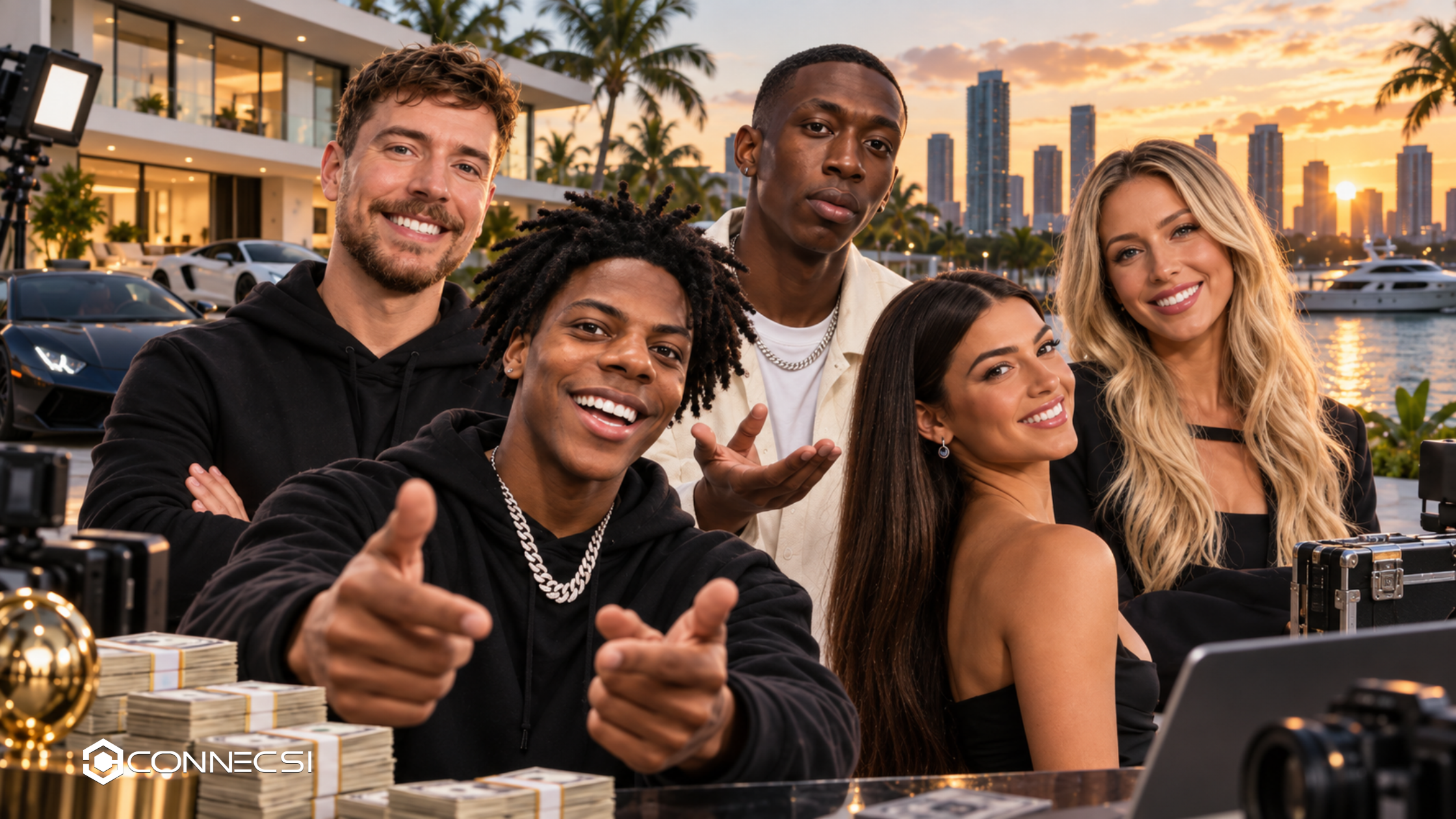
Featured image is an original editorial illustration created for Connecsi.
More insights for you.
What Your Favorite Creators Actually Earn: Inside the Highest Paid Creators of 2026
MrBeast made $300M. Another creator made $31M from just 10 million followers. Here's what the top 10 actually sell, and the do's and don'ts to borrow.

Your UGC Portfolio: You Need 5 Videos Before Any Brand Will Pay You
Most new creators pitch with nothing attached and blame a saturated market. Five sample videos changes every conversation. Here's exactly what to shoot.

Influencer Marketing Attribution: Why You Still Can't Prove What Worked
Your finance lead asks which sales came from creators. Most brands can't answer. Here's why the tracking breaks, and the stack that actually holds up.
Fresh insights.
Straight to your inbox.
- Creator partnerships
- Campaign guidance
- Industry insights